TeenTix Logo
Login
Sign Up

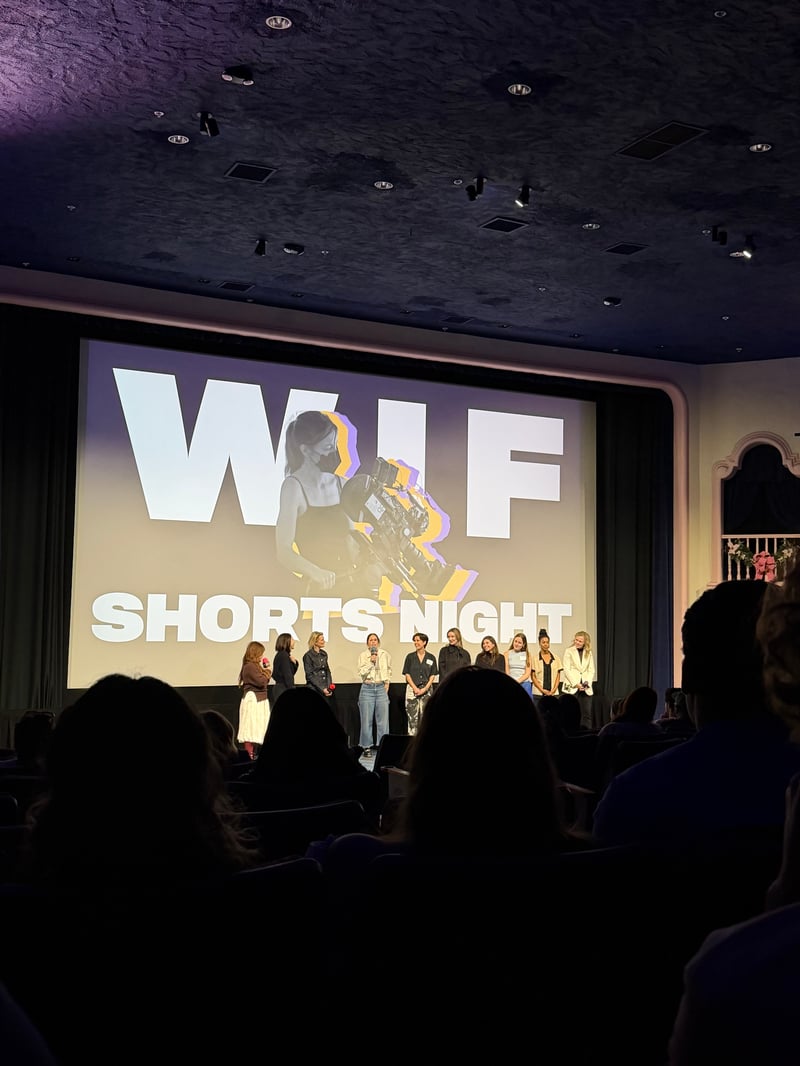
WIF Shorts Night at Vidiots

IMG 6606

On December 11th, I attended the 2025 WIF Shorts Night at Vidiots in Eagle Rock—one of my favorite spots in LA to catch a film (or in this case, six films). As a film buff, I couldn't pass up the chance to return to a theater that never disappoints.Women In Film (WIF), founded in 1973 as Women In Film Los Angeles, advocates for and advances the careers of women working in the screen industries. They champion women at every level of experience, both in front of and behind the camera, working toward parity and cultural transformation.The evening featured six compelling short films, plus all the perks: free popcorn, fountain drinks, and an impressive spread of charcuterie boards. After the screenings, we got to hear directly from the filmmakers during a Q&A talkback. While tickets were normally $20, my TeenTix membership got me in for just $5—an absolute steal.As an aspiring female director, being surrounded by fellow women filmmakers in my favorite Los Angeles theater felt genuinely inspiring. Hearing the filmmakers share their creative motivations and the real challenges they faced, from tight budgets and scheduling conflicts to unpredictable weather, gave me invaluable insight into what a film shoot actually demands. Sitting in a room full of female cinephiles, I felt welcomed, energized, and excited about what's possibleIf you're looking for more experiences like this, I can't recommend TeenTix LA enough. Sign up for your free TeenTix Pass to access incredible film screenings, Q&As, and other cultural events across the city. These aren't just passive entertainment; they're opportunities to connect with working artists, learn directly from people doing what you dream of doing, and find your creative community. Events like this screening reminded me that the path to filmmaking isn't just about talent or luck; it's about showing up, listening, and letting yourself be inspired by others who've walked the road before you. Your next spark of inspiration might be just one event away.

Read More

Youth Theatre Conservatory with The Unusual Suspects

USTC Blurb Photo v2

If you're a 9th or 10th grader who loves theatre—whether it's the drama, the design, the behind-the-scenes magic, or simply the thrill of a live performance—the Youth Theatre Conservatory is your chance to go from audience member to creator. Kicking off this September in Pasadena, this free, yearlong program offers exclusive access to professional artists, hands-on training in acting, writing, directing, and stage design, and the opportunity to bring your own stories to life on stage. You’ll attend real performances, collaborate with other passionate teens, and create bold original work that reflects your voice. No experience needed—just imagination, curiosity, and a love for storytelling. Spots are limited, so don’t wait to apply!

Read More

From Flow to Fire: Terence Blanchard Brings Both Jazz and Opera to Life

Screenshot 2025 07 18 at 2 10 22 PM

The moment Terence Blanchard stepped onstage, sporting bedazzled silver sneakers paired with an otherwise casual full-black ensemble, his audience erupted into applause. Blanchard, the esteemed composer and jazz trumpeter, is the first Black composer to premiere an original opera at the Metropolitan Opera. He is also well known for his work scoring films such as Their Eyes Were Watching God (2005), BlacKkKlansman (2018), and Harriet (2019). His performance on April 6, the first in the Soraya’s LA Seen series, served as a sufficient introduction to his range, albeit one that failed to showcase the full breadth of his work’s emotion and storytelling. The performance opened with a collection of tracks from Blanchard’s 2005 album, Flow, performed by Blanchard and his band, the E-collective. There was Charles Altura on electric guitar, Victor Gould on keyboards, Dale Black on bass, and Oscar Seaton on drums. The set opened with the album’s title track, which set a moody, groovy tone for the evening. The first song was swiftly followed by the songs “Benny’s Tune” and “Wandering Wonder,” which gradually built up the energy of the performance. The only pitfall of this section of the night would have to be the distinctly AI generated visuals on screen. The visuals, a myriad of sci-fi-esque images featuring women clad in technological accessories and a manned space exploration mission, ultimately distracted from the performance on stage. The futuristic, space-age aesthetic blurred together as the music became more and more frantic, adding to the atmosphere. However, the AI blunders were hard to overlook. Four-fingered hands, eyeballs with multiple pupils, and humans with one too many limbs adorned the screen, seeming almost comical in the context of the performance. Following Flow, the next portion of the night highlighted a series of selections from Blanchard’s 2013 opera, Champion. Blanchard was joined by baritone Justin Austin, soprano Adrienne Danrich, and the Turtle Island Quartet for the operatic performances. Champion, inspired by the life of boxer Emile Griffith, was done a bit of a disservice during the show. The vocal performance was undoubtedly impressive and emotional, but only a measly four excerpts were featured. Even more confounding was the fact that these selections were sung out of chronological order, detracting from the opera’s storytelling. After intermission came a series of selections from Blanchard’s Fire Shut up in My Bones (2019) – Blanchard’s second opera. The evolution of Blanchard’s operatic composition was evident in the transition between Champion and Fire. These selections incorporated plenty of jazz elements, which distinguished them from the more classical sound of Champion’s excerpts. Fire also occupied 45 minutes of the evening, and this added breathing room contributed to a more cohesive storytelling experience. There was more variation in the selections performed as well. One of the standout selections was a duet from Act Three of the opera. In it, Charles (Austin) reveals to his lover Greta (Danrich) the secret that he was molested by his cousin as a child. The performance reaches its climax when Greta rejects Charles in favor of another man, leaving Charles pleading for her affection. Overall, Fire stood out as a well-thought-out performance, almost eclipsing the Champion selections from the first half of the evening. Blanchard closed out the night with a performance of “Sprocket”, a surprise song dedicated to the legendary Herbie Hancock, who happened to be in the audience. This performance was my personal favorite of the night. It was fun and free, a sharp departure from the more serious atmosphere of the operatic selections. Overall, Blanchard’s night at the Soraya was an engrossing showcase of his impressive body of work. Besides the AI generated visuals and the disjointed presentation of excerpts from Champion, the performance successfully highlighted Blanchard’s range as a performer. While definitely a flawed representation of his talents, Blanchard’s performance truly evidenced his standing as a celebrated figure in modern day jazz. 

Read More

Behind the Scenes with a Curator — and Why Art Matters for Teens

Screenshot 2025 07 03 at 1 38 40 PM

My name is Zack, and I’m a high school intern at TeenTix LA! A couple of weeks ago, I got the incredible opportunity to interview curator Kris Kuramitsu about her recent show, her curating process, and how it all relates to the work we do at TeenTix LA. Kris is the curator of a show at the Armory Center for The Arts, titled “my hands are monsters who believe in magic.” The exhibit highlights Asian American contemporary artists whose work explores themes of history, identity, and self-understanding. About a month ago, my family and I took the drive to Pasadena to visit the armory for ourselves and experience the art firsthand—it was amazing! Each work was both unique to the artists’ perspective while also helping create the greater context that the show aimed to emphasize. I deeply appreciated the work Kris did to bring together Asian American artists of intensely varying backgrounds, identities, and perspectives.Besides myself, my family also loved the show—my mom described it as both fascinating and somewhat disturbing. In light of this interview, I’ve written some short excerpts from some of the many insights she was able to share:

——————————————————————————————————————————

Read More

From Scars to Art: Alabaster’s Rendering of Empathy in Our World Today

Screen Shot 2025 04 01 at 11 53 48 AM

Goats, women, and paintings: it is hard to predict exactly what the play Alabaster is about when first looking at its poster. This nontraditional Southern play, running at the Fountain Theater until March 30th, elegantly connects these three seemingly unrelated topics to comment on the role of art, relationships, and resilience in our world today.The central plot revolves around two women: June (Virginia Newcomb) and Alice (Erin Pineda). June is a tornado survivor who spends her life painting, talking to her goat Weezy (Carolyn Messina), and tending to her farm, all as a means to isolate herself from the outside world. June invites Alice, a photographer from New York City, to take pictures of her scars so that she can include them in a greater artwork on female survivors. This relationship is initially tense – June’s sudden, awkward outbursts makes Alice uncomfortable and closed off – but as they each gradually reveal their tormenting histories, the two find a comfort in each other that goes beyond the confines of friendship.As June and Alice unravel their histories to each other, another story takes place outside the Alabama farmhouse: Weezy and Bib (Laura Gardner), two goats, experience life on the farm. Although the goats are dressed like humans and can speak to the audience and the human characters, Messina and Gardner’s facial expressions are unmistakably goat-like. While this might sound unsettling, these actresses made their unusual characteristics seem completely natural. Weezy, the younger goat, brings a lightness and humor to this intense play, sometimes revealing June’s inner thoughts, conversing with the humans, or sharing her own opinions to the audience, acting as both a narrator and a character.Although the story is filled with people losing loved ones, the relationships that form as the characters share their grief brings a sense of hope to the narrative. Messina succinctly sums it up: “the whole play is about caregiver connection.” Messina further explains that Weezy is the ultimate caregiver – she provides “tough love” to the characters and the audience, keeping people honest and helping June let go of her traumatic past. Alice also serves as a sort of guide to June, giving her a chance to explore the world beyond her farmhouse while she learns to cope with her own pain as well. Forming relationships is not the only way characters find ways to cope with their past. June’s passion for creating folk art and Alice’s career as a photographer provide an outlet for their suffering. While Alice confronts suffering by documenting its effects on physical bodies, June uses art to escape her trauma, painting idyllic scenes on wood scraps she refuses to display publicly. This makes viewers question the role of art – is it meant to provide a place to escape reality, or confront it? When examining the purpose of this play, it seems the latter is true. After all, this play, written by Audrey Cefaly, depicts a grim and realistic (but hopeful) narrative – with a tone far different from the idyllic scenes in June’s paintings. In fact, the directing by Casey Stangl emphasizes the realism of Cefaly’s play. The characters stay on stage during intermission, stretching, reading, and eating. Weezy wanders into the audience, sitting in the aisles during the play. Fiction meddles with fact. The role of the possibly divine, mind-reading goats further blurs the line between reality and imagination. At several points, one questions the existence of Weezy – is she June’s conscience, a God whispering the truth to Alice, or just a goat with a voice? This question never gets answered, and doesn’t need to. Cefaly and Stangl suggest that reality can blend with fiction to reveal a truth.This play reveals many truths – too many to cover in a single article. As Pineda explains, “there is no core to this play.” Pineda states that the complexity of this play makes it so that everyone interprets it differently when watching it – all watchers can uniquely experience the play as they relate it to their personal circumstances. As a recent mother, Pineda finds this play enriching, and finds endless ways of experiencing the play each night as she plays Alice. The malleability of this play’s message makes its title fitting. The word Alabaster is more than just a tornado-prone town in Alabama – it is a porous rock, Messina points out to me in our interview. The stone is soft: it is easily broken down by natural elements, and therefore serves as an excellent medium for art. In other words, Alabaster is vulnerable to pressure, but a source of beauty when rightly treated – but aren’t we all?

Read More

On The National Language Photography Exhibit Speaks to the Heart

Screen Shot 2025 01 07 at 12 44 02 PM

Curled up in the center of a plain with reaching stalks, there is a woman with a rainbow flair. She wears a black traditional Indigenous skirt speckled with white and banded with pinks and greens. There are long strands of colorful braided cloth wrapped around her waist, gracefully spread in the grass behind her. Eyes contemplatively closed, hand caressing her hair gently, and arms and legs protectively held to her chest, her character embodies pure individuality, acceptance, and patience.There is a word in Sauk that describes this photograph by B.A. Van Sise: “opyêninetêhi.” In English, “my heart is taking its time.”In Van Sise’s photography exhibit On the National Language: The Poetry of America’s Endangered Tongues at the Skirball Cultural Center, Native American culture is on full display. One word from various rare Indigenous languages—Tongva, Nahuatl, Plains Sign Language, and more—is interpreted by Van Sise in a photograph. Some words are also accompanied by a poem, titled with the English translation of the word. The beauty of the words lies in the fact that their emotional and poetic connotation only exists in the language in which they were born; through translation, their meanings are lost.My experience at Van Sise’s exhibit is one I hold close to my heart. Van Sise tells the story of each language in a unique and captivating way, transferring emotion between languages. I also admired his creativity with the photography medium, such as printing one photograph on a tree bark and ripping parts of other photographs to reveal another photograph layered underneath.Of Van Sise’s 46 works, there were several photographs that particularly resonated with me:

1. Plains Sign Language

Read More

A Christmas Carol at A Noise Within

South pasadena news 12 08 2021 a christmas carol anw 2

Imagine living in Victorian-era London during the Christmas season. There are decorations placed about—the streets twinkling with fairy lights and colorful ribbons to bring in the festive cheer. A children’s choir can be heard in the distance, going door-to-door and sharing joy in their music. Families are gathered in their houses, laughing, smiling, exchanging gifts, and sharing a Christmas feast. However, one particular home stands out from the rest. No tinsel laced on the roof, no tree put up, no carols to be heard from inside the house. This home belongs to none other than Mr. Ebenezer Scrooge, the very main character of English writer Charles Dickens’ A Christmas Carol. This story was wonderfully brought to the stage by Julia Rodriguez-Elliott and Geoff Elliott, the directors of A Christmas Carol at A Noise Within Theatre. Although I am familiar with this classic, I have never seen a theater-adapted version of it, so this experience was very exciting. On the night of Christmas Eve, Ebenezer Scrooge (Geoff Elliott), an elderly miser who hates the holidays, is haunted by the ghost of his long-dead business partner, Jacob Marley, who warns him about three spirits that will visit him: The Ghost of Christmas Past, Present, and Yet to Come. Throughout these visits, Scrooge witnesses the effects of his ignorance and negativity, and it allows him to feel. The play was divided by one intermission, and the first part before the break had the perfect ending. It captured Scrooge in a moment of emotion—a moment under the spotlight when he realized his own misery in a particular scene with the Ghost of Christmas Present.One thing I noticed throughout the play was the amount of thought that was put into the costumes. Each scene had its colorful contrast—the monochrome palette of the Past, the vivid pop of the Present, and the somberness of the Future communicated the indirect message of the costume designer’s creativity to the audience. I especially adored the chromatic complexity of the Ghost of Christmas Present, played by actor Anthony Adu. Not to mention, he did an amazing job of portraying his character—a majestic and cheerful spirit that guides Scrooge through the events of the holiday season. It completely matched his costume, a robe adorned with fruits and leaves which I believe is supposed to represent the festivities of the “present” Christmas. It is clear that designer Angela Balogh Calin put much effort into styling the cast. Another aspect of the play I would love to mention is the set that brought everything together, and not just the props and pieces themselves. The quick changes that the ensemble was always able to keep up with were so professional. As someone with experience in theater, I was impressed with everything. Although the set in itself was quite simple, the lighting and the way the actors used the space still made the stage come to life. One detail that really caught my attention was during the beginning when a real flame was used to light a candle prop. I found it so interesting how they decided to include this because it added a realistic approach to the set.Although the visuals of the play had their spotlight, the true MVP was the acting itself. The emotion that the actors were able to capture in their performance was absolutely magnificent. Scrooge’s pure terror at the visit of his partner’s ghost, the lively Christmas celebrations of Scrooge’s past, the grief of the Cratchit family’s loss in the Ghost of Christmas Future’s vision—they were all emotions that I could actually feel. One scene that especially struck me was when Scrooge saw his grave in the future. The despair and desperation that he showed the spirit when he realized his fate was something I have never seen before. It really showcased Elliott’s talent as the main character, and even made me realize how well the play was adapted for the original story of A Christmas Carol. The way that the directors were able to implement the onimosity and thrill of the classic tale was perfect. It was something that I was not prepared for—the entire performance exceeded my expectations by so much, especially because it has also been a while since I’ve seen a live theater production as an audience member. The atmosphere of each scene was adapted carefully, and every actor worked together in harmony. There wasn’t a moment where a character looked out of place.If in the mood for a Christmas classic that will place you through both sentiments and thrills, A Christmas Carol is the perfect play—whether it's viewing it at A Noise Within (they put it on every year!) or cozying up and reading it on the couch. Now that I have experienced both options, I think that it’s safe to say that this story, with over 100 adaptations, is something that is always available to bring out every holiday season!

Read More

La Cage Aux Folles at Pasadena Playhouse

Download

 Less than a week before I saw La Cage aux Folles at the Pasadena Playhouse, I went on a school retreat that focused on reflecting on the four types of love as outlined by C.S. Lewis: storge (family love), philia (friendship love), eros (romantic love,) and agape (love for a higher being or calling.) While watching La Cage, I couldn’t help but think about the similarities between the themes of the play and the retreat I had gone on. The two primarily overlapped in emphasis on the importance of having the different types of love in one’s life, and how the purpose of human life is not to simply be an individual but to seek out people who make you feel complete. I think the type of love most present in La Cage are storge (family love) and eros (romantic love). Love is the catalyst for all the events in the musical as it pushes and pulls through the story which goes as such: a married couple, Georges and Albin are the proprietors of a drag club, La Cage aux Folles, on the French riviera. Georges is the club’s MC and director, while Albin is the main drag performer in the club’s nightly cabaret. When Georges’s son Jean-Michel returns from traveling, he announces that he is engaged to a woman called Anne and her parents are coming to visit. As it figures, Anne’s father, Deputy Dindon, is a conservative politician seeking to close down drag clubs, such as La Cage. Trouble arises when Jean-Michel tells Georges that Anne’s parents are under the impression that Georges is a retired diplomat married to Jean-Michel’s absent mother, Sybil. He asks Georges to send Albin away and invite Sybil during the visit so the Dindons can be led to believe Jean-Michel has respectable, heterosexual parents. Georges reluctantly agrees and informs Alban of the plan. Act one culminates in a song, “I Am What I Am," where Albin expresses the hurt he feels by being deliberately excluded from Jean-Michel’s wedding plans. The second act opens with Albin and Georges reuniting on the beach following Alban’s overnight absence. They agree that Albin can attend dinner with the Dindons if he attends as Jean-Michel’s macho Uncle Al. A song follows where Georges instructs Albin on how to correctly perform masculinity and come across as straight. Things begin to fall apart on the night of the dinner when Sybil abruptly cancels and Albin gets spooked right before the Dindons arrive. Georges and Jean-Michel frantically (and hilariously) try to make the situation seem normal until Albin arrives in drag as Jean Michel’s mother. After the butler Jacob fails to prepare dinner, Albin secures a table at a sought after restaurant, Chez Jacqueline, and the party goes to dinner. At Chez Jacqueline, the owner of the restaurant asks Albin for a song and everyone (omitting Deputy Dindon) sings and dances to “The Best of Times” until Albin’s wig gets snatched at the crescendo of the song. After traveling back to Georges and Albin’s home, a horrified Deputy Dindon asks for Anne to not marry Jean-Michel. She doesn’t listen to him, and Dindon and his wife try to leave. Their exit is stopped when they realize there is a crowd of photographers outside of La Cage aux Folles making it impossible to leave without having a picture of himself taken at an establishment his platform seeks to close down. Georges offers to help Dindon escape; he gives his blessing to Anne and Jean-Michel’s marriage. Dindon agrees, and the show culminates in a number where all the Dindons escape by discussing themselves as drag performers at La Cage


Read More

Robbin From the Hood Plays the Corporate Game for Good

Unnamed

I’ll be honest, when I went in to experience Robbin from the Hood, I was expecting a faithful, modern retelling of Robin Hood. I thought I would find stereotypical references such as capers and forest friends. Instead, I found myself invested in the tale of Robbin, an ambitious, hot-tempered, seventeen year old girl who lives in an inner-city neighborhood. Her hopeless surroundings caused by poverty drives her to look for a way out.The play opens with an elderly man in a wheelchair flipping through newscasts. Sounds of dystopian news reports on the rising poverty rates fill the intimate theater, until the man eventually turns on The Lone Ranger. The relative calm of the scene is quickly interrupted by the boisterous arrival of Robbin (Iesha Daniels). The play only gets more energetic from there, with the first showing of Juan, Robbin’s spirited best friend. His vibrant nature is what kicks this play into high gear, as the two feed on each other’s zeal.  It’s pretty clear from the get-go that you’re in for a ride.  This liveliness carries through the whole first act. It’s here where we learn that Robbin's math genius and Juan’s artistic giftedness have earned them summer-long internships at Kennedy Global, a multi-billion dollar company. Despite the rather menial work they’ve been assigned, it’s still more stimulating than their academic environment, which was underfunded and overpopulated. They hope to climb the corporate ladder out of poverty and finally be able to take care of their families. This is the act that also introduces two Kennedy Global executives, Kyle and Margaret, whose initial generosity contrasts with their ultimate motives.  Despite Kyle’s early misgivings about hiring teens from at-risk neighborhoods, he is reluctantly convinced by an insistent Margaret to let them join the company. Robbin and Juan don’t seem to notice any red flags however, as they quickly settle into their new, high-paying jobs.One thing that really stood out to me was the acting. Robbin’s (Iesha Daniels) confident, sassy attitude is balanced by her moments of vulnerability. The scenes where she worries over her ailing grandfather and financial situation are the ones that best enrich the play. Juan (Enrike Llamas) has complexity as both a funny best friend and a person who’s growing weary of his unpromising surroundings. William L. Warren, who played Grandpa Percy, was convincing in his portrayal of a beloved elderly man facing decline. His shuffling feet, shaky grasp, and weathered voice helped make every moment of his stage time thoroughly believable. There are no stock characters here, every role is complex and well-defined.After a ten minute intermission, I returned to the theater excited for act two. Much to my surprise and delight, I found myself enjoying act two even more than its predecessor. The restless energy of the first act has now subsided. It has been replaced with more reflective moments of emotion that reveal an array of character motivations. I had the opportunity to interview the actors following the show, and as starring actor Iesha Daniels put it, “I think the physical energy of the first half is what drives the emotion in the second half.” This is made clear in the prison scene with Robbin and her incarcerated, yet beloved Uncle Charlie (Joshua R. Lamont). The scene serves as the crucial turning point where Robbin learns deeply disturbing truths about the way Kennedy Global makes their money. The worst part is that these truths harm the ones she loves most. She now faces a conflict of interest between trying to do what’s right, and keeping a job that allows her to financially provide for her family. At only seventeen, our protagonist is forced to ask herself some pretty difficult questions. How far should one go to end cycles of poverty that plague your community? Is it worth the immediate risk, especially when you have been given an opportunity no one else you know has?  An answer to these questions seems to appear in the form of an abandoned community project that Robbin hopes to revitalize. Her quest to do so will have the audience completely invested in the many twists and turns she faces along the way.  While I was pleasantly surprised by the deviations the play took from the original Robin Hood, similarities between the two are still present upon reflection. Beyond the obvious theme of stealing from the grossly wealthy to empower the impoverished, Robbin from the Hood owes a lot of its impact to the original story. Indeed, there are no Merry Men clad in Lincoln green for this retelling, nor are there any crossbows to be slung. But what the two stories do have in common is the scrappy underdog spirit shared by the two protagonists. Both Robins are temprental, with a tendency to scoff in the face of authority. And yet, both Robins have a caring side to them, a side willing to do anything for the ones they love. Juan serves as a combination of Will Scarlet and Little John, Robin Hood’s two most loyal friends. But perhaps one of the strongest parallels is the fact both Robins pay a price for their biggest act. Robin Hood dies after killing the corrupt Guy of Gisbourne, in an effort to protect his community, and Robbin faces a harsh punishment for doing the same. Their final sacrifice makes them all the more noble.The thing that sets Robbin from the Hood apart from its predecessor is the way it portrays the experiences of talented, impoverished youth. Robbin’s potential is ultimately left untapped and punished, simply because she doesn’t obey the corrupt status quo. Iesha M. Daniels, that actor that plays Robbin herself says, “The ending is a really crucial element to the play because it fully grounds us in reality. This is what happens to girls like Robbin. Black and brown girls who are brilliant, compassionate, and want to change the world and support their communities are crushed and suppressed again and again.” Robbin represents the experience of the disadvantaged, those left behind by a system that seems to work against them. She forces us to question our assumptions about people in at-risk communities. Are they all aimless, or simply given nothing to aim for? And what happens to talented youth when they are left unnurtured?  In this way, Robbin exists to remind the audience of an important lesson: not all people get second chances, even when they should. Overall, Robbin from the Hood is definitely a play worth seeing. Its well-crafted plot, strong actor portrayals, and timely message come together to make an engrossing theater experience. Viewers will find themselves shocked at Robbin’s last act of selflessness, which serves as a reminder of how far some will go to level the playing field. This play acts as a  sharp rebuke of capitalism and an eye-opening lesson on how corporations take advantage of poor communities. Robbin from the Hood connects with the audience on an emotional level. In the words of William L. Warren, the actor who plays Grandpa Percy, “I think this play is about grief…and especially the love that comes along with it.”   

Read More

Reframing Tragedy: Interview with Veteran Multitalented Improv Comedian, BJ Lange

Screen Shot 2024 07 29 at 3 01 55 PM

Welcome to the first-ever segment on the Teentix LA Podcast! I was incredibly honored to have the privilege of interviewing our first guest, BJ Lange, a four-pound, four-ounce preemie, military veteran, Applied Improv Comedy Resilience Instructor, Geffen Teaching Artist, two-time cancer survivor, and Improv Extraordinaire. (Among many other things). In this episode, we’ll cover a very SparkNotes version of BJ’s career, from balancing his passion for military service and performance to his dedication to educating and inspiring future theater-makers. I really enjoyed speaking with BJ and hope you folks enjoy getting a little behind the scenes of what goes on inside the mind of BJ Lange! (I hope I do you justice BJ!)

BJ would also love to shout out an upcoming event at the Geffen Playhouse that he has a role in curating as a teaching artist. Beyond the Barracks, happening on August 5th, 8 pm, is the culminating performance of a 10-week theater-making intensive aimed at highlighting the stories of military veterans with pieces ranging from military to personal life. Tickets can be reserved for free by following this link: https://secure.geffenplayhouse.org/overview/beyond-the-barracks-2024

Follow BJ here!

bjlange.com

https://www.imdb.com/name/nm1293295/

https://www.instagram.com/bjcomedy/

Without further ado, the following is the transcript for the podcast (with appropriate timestamps). I’ve never realized how many times I actually say “kind of” or “you know.” I guess it's the LA in me. Hopefully, you folks aren’t too bothered by my inner valley girl.

Ghino (00:00)

Hello everyone, welcome to the Teentix Podcast. I'm with special guest BJ Lange. Welcome.

BJ @bjcomedy Lange, He/him (00:07)

Hello Ghino thanks for having me

Ghino (00:09)

Of course, of course. And let's just get started. So I want to focus on your early career and I mean like really, really early, like high school, like early, like high school kind of early college kind of age. What was your mindset at that time? Where did you think you were going to end up? What were your dreams? What were your aspirations looking like?

BJ @bjcomedy Lange, He/him (00:37)

Man. Well, Ghino I will take you back a little bit even further than that in that I was already ready to get on stage. I was four pounds, four ounces. I was a preemie and I was my mom's fourth child. And let's just say they were not ready to receive me in the delivery room. And literally I flew out and fell into the pan.

Ghino (00:41)

Okay.

Yeah. Gotcha.

Yeah.

BJ @bjcomedy Lange, He/him (01:06)

And that's literally how my life started.

So I'm originally from St. Louis, Missouri, born and raised in St. Louis, you know, Midwest, North City boy. And I used my dad's personality and his energy and took

in a more professional route. think that deep down, my dad wanted to get into comedy and performing, but he didn't use the skills. And that way he did use those skills. On the sales side, he ran his own business and that kind of stuff. So in middle school, I really kind of saw a little path. Like I did...

Ghino (01:34)

Yeah.

BJ @bjcomedy Lange, He/him (01:54)

drama club, I was in an acting class. That was the first time I ever dabbled in improv, which as you will soon hear, that became a big portion of my life. And then in high school, I did the musicals at my high school. I grew up in a predominantly black neighborhood. I was one of a few white guys where I grew up. So I was always trying to use my personality and my energy to kind of fit in.

Ghino (02:14)

Mm -hmm.

BJ @bjcomedy Lange, He/him (02:21)

I was the goofy white kid that would always crack jokes, always had a joke at the ready and beatboxing to try to fit in and to do whatever, which I love beatboxing. So trying to do whatever I can to use these skills. And I think in probably my sophomore or freshman year of high school, I

Ghino (02:24)

Yeah. Yeah.

Hehehe

Mm -hmm.

BJ @bjcomedy Lange, He/him (02:46)

knew that I wanted to get into entertainment and this is terrible because I'm now 44 years old, Ghino. But I think a lot of the adults who may listen to this will probably understand. I still don't know exactly where I want to go. I know there are things that I want to do. I know that there are things that I have done that I want to do more of, but I really don't know specifically. So do I want to do...

Ghino (02:53)

Mm -hmm.

Yeah. Gotcha.

Yeah.

BJ @bjcomedy Lange, He/him (03:16)

film, TV, commercial, theater, know, hosting work. Well, I do all of those things, you know, so I'm always trying to do everything. It's really hard to kind of narrow it down, but to simplify it, I always tell people where I am now in life is improv comedy is my highway, and then I get off the highway to do other things. Maybe I shoot a commercial or I write some sketches and shoot those with my buddies or, you know, do some sort of theater.

Ghino (03:22)

Yeah.

Gotcha, yeah.

BJ @bjcomedy Lange, He/him (03:46)

There's that, and then I went to junior college and studied acting and then took classes at the Second City and I hosted a lot of events, a lot of MTV events and got into MC work, live event hosting, then television hosting, eventually finding my way out to Los Angeles and I've been in LA now for 14 years and following that path.

Ghino (03:53)

Mm -hmm.

Very cool. Well, I know you were talking about kind of not knowing exactly like where you want to be headed right now, but I think that's actually a sigh of relief because, you know, speaking of my personal experience and a lot of those that may be listening, you know, we think that adults have it all, have it all, you know, planned out for them. And, you know, if people actually understand that, you know,

BJ @bjcomedy Lange, He/him (04:38)

Yeah

Ghino (04:43)

we're kind of all the same, we're all human and we don't have it all figured out. I think that'll give a lot of inspiration to people that are listening. And yeah, and that brings me to my next question. I know you said that your dad had a similar skillset that you had, but used it in a different way.

BJ @bjcomedy Lange, He/him (04:54)

Absolutely.

Mm -hmm.

Ghino (05:09)

kind of you were talking about how you found that kind of performing was your thing early on. Was Dad supportive of this kind of thing that you wanted to pursue?

BJ @bjcomedy Lange, He/him (05:24)

Yeah, I'll be honest and I did a great monologue and I don't know if you have show notes here or not Ghino, but maybe I can share the link with you to put in here in case people want to see it. Two years ago I did a veteran monologue at the Geffen Playhouse and my cultural identity monologue was based around access to the theater because to me the foundation of my entertainment career as a whole is quite simply theater.

Ghino (05:34)

Yeah.

Mm -hmm.

BJ @bjcomedy Lange, He/him (05:52)

and access to the theater and what it means to me. But when I go back and I look at were my parents supportive and my stepmom who pretty much raised me is a graphic designer, so an artist by nature. So she was really supportive of being creative and all of that stuff. And my dad, I think is more of a business workaholic, you know, the hustler, you know, so that's where I got my work ethic and my drive.

Ghino (06:09)

Yeah. Gotcha. Yeah.

Mm -hmm.

BJ @bjcomedy Lange, He/him (06:23)

But I don't really think that they saw early on as I certainly did not really until after high school the possibilities of actually making a living doing what I love the problem it goes back to your previous question of like well What does that mean? You know, am I am I gonna just do theater? Am I gonna host am I gonna get into MC work, you know for live events and use these talents the

Ghino (06:37)

Mm -hmm.

BJ @bjcomedy Lange, He/him (06:53)

The way I see it, diversifying your skill set is important so that way you can make ends meet. And I think when my parents finally saw, listen, they were gonna let me do whatever I wanted to do and they were understanding, especially in probably the last 10 or 15 years, right after I moved out to LA and I was talking about how much of a struggle it was for me to be out here like,

Ghino (07:09)

Yeah.

BJ @bjcomedy Lange, He/him (07:22)

I had a full -time, well not full -time, but three quarters full -time part -time job, which was my actor hustle. And then I'm taking classes, I'm doing auditions, I'm constantly doing improv and sketch and doing meetups and still trying to do the show business and the hustle of it. And so I'm sharing that with my parents and my dad

you know "why don't you carry on your federal service?" Because I have a military background as well. I served in the military part time. So I think that it was hard for them to really grasp like, is it feasible? And it's a, we know it's a long game. We know the acting career specifically is a long game and you need to know that going in and be okay with

Ghino (07:57)

Yeah.

BJ @bjcomedy Lange, He/him (08:19)

And then to diversify so I know it comes from a place of you know wanting to protect your kids because I see it all the time where I teach I I teach at multiple places and I see parents that come and I go "is this really possible I think Johnny should you know be an accountant and then do this on the side," you know, and that's it's hard to really You know battle that mentality Because you're the only one that's going to know how bad you really want to pursue this dream

Ghino (08:29)

Yeah.

BJ @bjcomedy Lange, He/him (08:48)

And I love surrounding myself with dreamers. I am a dreamer. I've always been a dreamer. Not like a lofty dream that like, maybe I'll be in space sometime in a space. But like, can I really do that? Could I really be on Broadway? Could I really be as a recurring character on a sitcom? In the answer, now I'm in a position where

Ghino (09:00)

Yeah.

Yeah.

BJ @bjcomedy Lange, He/him (09:16)

where I could see a little bit more paved surface to get there. But I know it was hard for my parents to see that. I know that was a really long answer to your question, but it's really not an easy question. It's challenging.

Ghino (09:24)

Mm -hmm. Yeah.

And speaking of you being an MC and a host for a lot of like live television and things like that early on in your career, how did you get your first like hosting gig or MC gig? And, you know, how did you, why did you stick with that?

BJ @bjcomedy Lange, He/him (09:52)

Well, I knew, like I said earlier, that you have to diversify the different avenues that you can make money. And I think using any of your natural talents, certainly anything for my fellow actors out there, anything that's acting adjacent will be of benefit because you're working in the industry, you're meeting people, you're connecting. However, when I moved out to LA, I kind of put a lot of

professional hosting stuff on the back burner because I was like, I'm an actor. I'm just gonna do film and TV and commercial and I'm gonna stop doing all that.

Ghino (10:26)

Yeah.

BJ @bjcomedy Lange, He/him (10:36)

I got mixed feelings about that thought process because I know that I really do have that skill and I enjoy it. However, I really want to challenge myself and this is always the actor's dilemma. It's like I'm always playing a paramedic because I play a paramedic like on multiple things right now. and because I have that skill set. but at the end of the day, like I'm just simply happy to work. Now, while I put all that stuff on the back burner, when I first moved out to LA

Ghino (10:52)

Yeah, yeah.

BJ @bjcomedy Lange, He/him (11:04)

had something bigger come up, which is more of a calling, because I always, there's a small part of me that also was like, I should host like a kids game show. You know, because that's my jam. Like, I grew up loving Nickelodeon's Legends of the Hidden Temple, which I know they rebooted. if I could host, and I actually auditioned to host Hole in the Wall.

Ghino (11:14)

Yeah.

Mm -hmm.

BJ @bjcomedy Lange, He/him (11:31)

I've auditioned actually to host quite a few things in recent years, but for a long time, I put that stuff away and unless something was big enough, like I kind of was like, no, I need to put more time over here. And that is true to some degree. Like you can't continue to do every damn thing because you need to be doing a little bit more in this focus. However, you also have to pay the bills, you know, so, so, so it's, it's, it's a hustle. So when I was in junior college,

Ghino (11:34)

Yeah.

Yeah.

Yeah.

BJ @bjcomedy Lange, He/him (11:59)

I worked for a syndicated morning radio program. was their stunt boy. And that opened the door for me for a little bit larger media type stuff. So this syndicated morning radio program had a lot of different opportunities that presented themselves. At some point I found myself working at Six Flags. So a lot of actors, you

Ghino (12:05)

Mm -hmm.

Yeah.

BJ @bjcomedy Lange, He/him (12:28)

get their start like, you know, doing little things at amusement parks and whatever. Oddly enough, Ghino, I know you're a fascination with amusement parks. So that's kind of fun. Little behind the scenes here for TeenTix podcast. The door really opened for me in the summer. I believe it was 2005. I was working for a virtual reality gaming company.

Ghino (12:36)

Yeah. Yeah. Yeah.

Mm -hmm.

BJ @bjcomedy Lange, He/him (12:57)

And when I say gaming, I'm literally doing the air quotations right now because it's not the virtual reality like we know today. Long story short, this company created this technology and they hired actors to, number one, bark like a show barker. So the person that's out front on the mic, hey, sir, come on over here. Are you wearing a red shirt? If you're wearing a red shirt, come on over here and check this out. I've got this for

Ghino (13:00)

Yeah.

Mm -hmm.

gotcha, gotcha, yeah.

BJ @bjcomedy Lange, He/him (13:26)

and they leased property or technically at that time, they managed property for games that were purchased by Six Flags, but they were managed by the company that created the product. So I didn't work for Six Flags, but I worked at Six Flags and they hired actors to do that. So you were either a barker and then every few games, which were like a 10 minute game, you would rotate.

Ghino (13:42)

Mm -hmm.

gotcha.

BJ @bjcomedy Lange, He/him (13:55)

And this was awesome. And this is where I got a lot. I mean my improv background exploded, not just because being out front on the mic, which in and of itself is a lot of talent and skill. But we went in the back and they had a green screen. It was actually a blue screen then like a chroma key. And you would pop up in the back in the little baby studio they had in the virtual reality that people were watching. So.

Ghino (14:06)

Yeah.

BJ @bjcomedy Lange, He/him (14:23)

we would memorize the animation that would play and then I would pop up as a character in costume and talk to you directly so I could see you playing the game along with 19 other people and I would say, hey, Ghino, shoot this bug and I would duck and then you would shoot it, you know that kind of stuff. It was awesome. And the nice thing about it is as long as you knew what was coming up next, you could adapt and improvise. And so my skills just exploded.

Ghino (14:30)

Yeah.

interesting. Yeah.

That's so funny, yeah

BJ @bjcomedy Lange, He/him (14:51)

So I did that for like a year at my local Six Flags in St. Louis. I left there when I got picked up by the company that owned the equipment basically and they took me on corporately so I trained actors all around the world. They flew me everywhere. I went to Germany and did stuff. We went inside Disney parks, Paramount parks, Six Flags.

Ghino (14:57)

Mm -hmm.

BJ @bjcomedy Lange, He/him (15:19)

tons of fairs and festivals and so I was constantly doing this and to be honest with you in my very early 20s I was making a lot of good money like I mean for an actor, you know like I was I was I was making it and we were having a blast and the people that I've worked with were awesome and Long story short that came to an end but in the summer of 2005 we were at the Ohio State Fair and I think this is kind of a turning point for

Ghino (15:32)

Yeah. Yeah.

Mm -hmm.

BJ @bjcomedy Lange, He/him (15:48)

new experiences coming into my life that kind of just fell into my lap. So at this point I had been doing a ton of dinner theater, community theater, I was in the St. Louis region, you know, doing the small short films and the occasional regional commercial, you know, I had an agent in St. Louis, you know, and doing all the little locally things that you could.

But we were up at the Ohio State Fair and I saw a man in the hot summer, August summer, wearing a suit, sitting across from me, listening and kind of chuckling to himself as I would crack jokes as people walked by to try to get them to come over and play the game. Because you gotta make it up to get people to come over and play the game. Remember, the more people that play the game, the more money I would get at the end of my shift. yeah. So, you know, it's the hustle, right?

Ghino (16:24)

Mm -hmm.

Yeah.

Yeah.

Gotcha. Yeah.

BJ @bjcomedy Lange, He/him (16:46)

And this guy's wearing a suit. I'm like dude. It's so hot. Why is he wearing a suit anyway? I'm cracking jokes on them and as I put the mic down we wear this like funny headset kind of like a body mic and He came over and he goes Hey, how much how much do they pay you to do this? And I was like what and he goes did you see the big thing when you came into the fair today? The big bubble and I was like yeah, it said Spike TV

Ghino (16:50)

Yeah.

Mm -hmm.

BJ @bjcomedy Lange, He/him (17:16)

Game Riot, it was like a video game competition, giant bubble, air conditioned, and like there were games and prizes, and you know, there were people shooting promo packages, you know, with big cameras back then. And I was like, yeah, I saw it. And he goes, I'm the producer of that. He goes, you're really funny. Do you want to be our Barker? And see, this was one of those things where like, I got the skillset and I know I could be a Barker, but I don't want to be a Barker. I want to be a TV host.

Ghino (17:21)

Yeah.

Yeah.

BJ @bjcomedy Lange, He/him (17:44)

Even more, I'm an actor. I'm an actor that uses his skill to be a TV host. That's the better way to describe how I feel I am. And I'm like, ugh. And he goes, I'll double whatever they're paying you. And I was on tour in about two weeks doing that. Yeah, yeah, no, for sure. So I did that, and then their show host who hosted the actual tournaments and stuff, some of which were televised, got sick.

Ghino (17:51)

Yeah, yeah.

Yeah, I mean you can't say no to that.

BJ @bjcomedy Lange, He/him (18:13)

So I ended up filling in for that and then and then this and then that got picked up by MTV too. And because I did that, people that produced that event also produced Spring Break, which I was a host for in Panama City Beach, Florida from 2006 to 2013, you know, and you meet all these sponsors and LG was a sponsor and I hosted the National Texting Championships because they met me.

Ghino (18:15)

you

BJ @bjcomedy Lange, He/him (18:41)

You know, so a lot of doors kind of opened from there and then I eventually moved to Los Angeles and started digging in more on the professional acting stuff. that's kind of the roundabout story there.

Ghino (18:57)

That's a really, really interesting story. I really love listening to all these, it's a small world kind of stories, where it's, you know, all these chance situations that kind of propel someone to be where they're at today. And it's also really interesting to hear about all the old technologies or the other things that they were using at Six Flags, like that virtual reality stuff that sounds really interesting.

how you were memorizing the animations for that. I imagine that in my head and it sounds so funny to me. So it was these people that were putting on these headsets at the park as you were performing it live or how was that working?

BJ @bjcomedy Lange, He/him (19:46)

Yeah, so I don't know what all I'm able to talk about, but I'll just give it from an audience perspective of what it is. So this guy, he was a Cornell graduate, really smart tech guy. And he got he had the patent on some sort of or what was then virtual reality. So he created these headsets, you know, which were

Ghino (19:53)

Gotcha. Yeah, yeah.

Mm -hmm. Yeah.

BJ @bjcomedy Lange, He/him (20:13)

way way precursor to like an Oculus right like they were super giant and then they had you know big kind of headphones on right now and then this this visual component so you could see and then in your right hand you would hold this controller where you can shoot and

Ghino (20:16)

Yeah, yeah, yeah.

Mmm.

BJ @bjcomedy Lange, He/him (20:35)

Um, and in short, in the back of the theater space, I'm going to say theater space in quotations, but like the event space, the game space under, under the seats and into the rear were one room had all the computers, right? Cause especially back then, like giant computers to like run all this stuff in 2004, five, six, seven, whatever. And then, uh, in the other room,

Ghino (20:45)

Yeah.

Mm -hmm.

Yeah. Yeah, yeah, yeah. Yeah.

BJ @bjcomedy Lange, He/him (21:05)

was a small air conditioned little studio that had a green screen, actually back then it was blue and fluorescently lit, a camera, a keyboard, and then a monitor where I could see on one side of the screen, the program video, which is the animation. On the other side of the screen, I can see the map of

Ghino (21:27)

Mm -hmm.

BJ @bjcomedy Lange, He/him (21:33)

all the people that are playing the game. So I see Ghino in seat 23. I could see you there. And to some degree, because if a lot of people are playing, we're hearing all the audio from everyone. So if someone's louder than someone else, if you were like, hey, Sheriff, I could be like, yeah, what's up, Ghino? Like I could literally, I know it's you because I see you moving on screen and asking a question. And so here's the fun part about what we would do. This is my favorite part of the whole thing.

Ghino (21:35)

Gotcha.

Yeah.

Hmm.

Yeah.

Yeah.

Yeah.

BJ @bjcomedy Lange, He/him (22:03)

The crazier you would get the audience, the more people that would want to come play. Now, yes, I would make more money sometimes, depending like if we're doing like sales bonuses or whatever. But the more fun you make it for them, the more fun it is for you, the actor. It's like if your audience is having fun, you're going to have a blast, right? So I would say, hey everybody, who's ready to play the game? Like as they're looking at the graphic, they don't even know who's talking. Like they don't know who I am. You know, they haven't met me yet because I'm not on screen.

Ghino (22:06)

Mm -hmm.

Yeah.

Absolutely.

Mm -hmm. Yeah, yeah.

BJ @bjcomedy Lange, He/him (22:34)

and I would say, if you could hear me, raise your hands up. And you would see a couple of people raise their hands up and I'd be like, I see you Ghino. Ghino, raise your right hand. And if you didn't do it, I'd be like, I told you to raise your right hand. And then they're like, and they would take their headsets off and they'd be like, this guy sees me. You know, they didn't realize that we have a camera. So that's kind of how the technology worked and we would just make people just get insane. All right, I want everyone to stand up and stomp their feet and scream.

Ghino (22:37)

Yeah.

Yeah, yeah, yeah

BJ @bjcomedy Lange, He/him (23:00)

I want ice cream like a big baby and people would do it, you know, so and we would just, you know, get crazy with the animation. You'd have to memorize the animation like there were multiple games. So there was one called Showdown at Shifty's, which was like a Wild West recreation. So I had like a sheriff vest, you know, and I'm like, you guys got to help me. You know, I'm the sheriff and there's a lot of, you know, criminals out here. All these outlaws are trying to take us

Ghino (23:03)

Hehehehehe

Yeah.

Yeah.

BJ @bjcomedy Lange, He/him (23:29)

Everyone point your finger out to the people that are walking in front of you at Six Flags and say, you're a criminal. And people would do it, know, people that are walking are like, what the hell? So anyway, yeah, what a fun, what a fun gig though. It really was a fun gig

Ghino (23:36)

Hehehehehe

Yeah. Yeah. That sounds like a blast.

All right, so kind of moving along, I know you said that you served the US Air Force Reserve as a aerospace medical technician. First of all, thank you for your service. Second of all, kind of how did you get into serving the military and how does that kind of combine with your whole improv kind of passion?

BJ @bjcomedy Lange, He/him (24:13)

Sure.

Ghino (24:15)

you know, comedic improv and military service is kind of on the opposite spectrum of things. So kind of where did that start and how did it kind of, how did it combine?

BJ @bjcomedy Lange, He/him (24:27)

Man, that's a great question, Ghino. I always wanted to serve. Like I always wanted to be of service. I was always the person that wanted to help out and do this. I come from a big military veteran family, so I knew at some point, hopefully I would join. It was just a matter of how could I work it out with my career? I always knew that acting was number one. I always knew that.

Ghino (24:33)

Mm -hmm.

Yeah.

Mm -hmm.

Mm -hmm.

BJ @bjcomedy Lange, He/him (24:57)

If I'm not doing that, like to me, I don't see a reason for living because that's all I want to do. However, I had this deep yearning to like continue to pursue it. And in 2006, I joined Civil Air Patrol, the Air Force Auxiliary. I was getting my private pilot license, private pilot certificate. I was doing pilot training.

Ghino (25:18)

Yeah.

BJ @bjcomedy Lange, He/him (25:24)

in 2006 back in Missouri, so this is before I moved to California. So it kind of gave me a little bit of an experience. I was able to see what it was like to understand command structure, to be of service, to go up in an aircraft, to have a duty assignment, to train. And of course it's all volunteer, and you're the civilian volunteer auxiliary of the Air Force, so it's non -paid.

Ghino (25:28)

Mm -hmm.

Yeah.

Mm -hmm.

BJ @bjcomedy Lange, He/him (25:53)

And then when I moved out to California 2009, like I kind of put that idea on the back burner while I focused on my career. And then in 2015, that thought just kept hitting my head over and over and over. And at this point I'm getting older. I was 35 years old and I knew that I couldn't go full time, but I knew that I could go part time and still get benefits. And it would hopefully, fingers crossed, still work with my acting career.

Ghino (26:18)

Mm -hmm.

Yeah.

BJ @bjcomedy Lange, He/him (26:24)

So I joined the Air Force Reserve. So it's one week in a month, two weeks a year, just like the National Guard. yeah, I mean, I went and there was a lot of other stuff that happened in there, but let me jump to the tail end of this. And the Second part of your question of how did it help out my career? Well, you know, we as actors use a lot of our life experiences and our characters and in the stories that we develop.

Ghino (26:28)

Mm -hmm.

Yeah.

BJ @bjcomedy Lange, He/him (26:53)

And this experience really helped to broaden out the type of characters that I can play or that would be more likely to be cast as because I understand now a lot more in depth, especially some of these challenging characters, whether not and not just military, you know, but someone who's dealing with depression and anxiety

Ghino (27:06)

Mm -hmm.

BJ @bjcomedy Lange, He/him (27:20)

you know, because prior to that I didn't really have any real life experience that I was familiar with. So that kind of helped me. And then more on the nose for that question, I served as a medic, you know, so I had this now military medical experience, which is, as you said, completely different than what I had already been doing. So on one hand, I have this art life, you know, of me wanting

Ghino (27:20)

Yeah.

Mm -hmm.

Yeah. Yeah.

BJ @bjcomedy Lange, He/him (27:50)

to pursue the arts and I just want to make the world a better place with art. Like I believe in it so much. And then on the other side, now that I'm going to go to be of service, I wanted to do something different than like I, originally I wanted to do public affairs. So, which is like taking photos, doing stories, you could also get into broadcasting. You could literally do that in the military. But I thought that

Ghino (27:54)

Yeah.

Mm -hmm.

Yeah.

BJ @bjcomedy Lange, He/him (28:18)

even though originally that's what I was going to try to do and the medic thing kind of fell in my pocket. I think that was still just a little bit too close to what I was already kind of doing. So me being a medic really carved out a new thing for me because cut to 2022, I got cast in my first episode and I have done nine since in General Hospital where I play a recurring Paramedic

Ghino (28:27)

Yeah.

Yeah.

BJ @bjcomedy Lange, He/him (28:47)

And the nice thing about that is the experience I got in the military specifically as a medic my military medical training Taught me what I was going to be doing in the action of the script so they didn't have to waste the time telling me similarly I work a lot as a medical technical advisor for film and TV as well. So people use me for that so which is all union and you know helps to build it up

Ghino (29:01)

Yeah.

Mm -hmm.

Yeah.

BJ @bjcomedy Lange, He/him (29:16)

That experience helped me to get more work. And I think the community and the military veteran entertainment community here is huge in LA and we all try to help each other. So a lot of doors open that I would not have expected.

Ghino (29:32)

So it's like help a fellow military Yeah. Veteran out. Yeah, exactly. So while doing some research, I really found this kind of like, I found this like mix of performance and military service, like that dynamic interesting.

BJ @bjcomedy Lange, He/him (29:35)

Yeah, vet.

Ghino (29:55)

I know you said that you originally joined Civil Air Patrol before actually serving. And I've realized that I've got my research all wrong then because I, doing my research, I thought that you joined the military first and then you joined Civil Air Patrol after you retired.

BJ @bjcomedy Lange, He/him (30:15)

No, yeah, Civil Air Patrol was, as it is for a lot of people, way to maybe see what else is out there. Certainly in our cadet program, which is age 12 to 21, it's a great way to kind of just be of service, kind of like a cadet corps, if you will. But our cadet program, our youth leadership program is great for younger folks, but I was already

Ghino (30:26)

Gotcha, yeah.

BJ @bjcomedy Lange, He/him (30:45)

know, late 20s at the time I joined, well, early 20s, when I joined Civil Air Patrol. So I wasn't 100 % sold on the idea yet on could I actually join the military. So this was just a way for me to kinda see what it was like, and maybe I would have never joined the military, but at least I would have slightly solved the hole in my heart.

to want to serve and be of service by volunteering in Civil Air Patrol. So already had a full -time acting career, joined Civil Air Patrol, then put all of that on hold to join the Air Force Reserve, and then went back. So a lot of vets who work in Hollywood do the military when they're younger, especially if they're active duty. They go in at 18 or whatever, right after high school, or go to college and then commission as an officer, or go to a service academy.

Ghino (31:16)

Yeah. Gotcha.

Mmm, gotcha.

BJ @bjcomedy Lange, He/him (31:43)

I kind of did it in reverse and I guess I'm a late bloomer Ghino. I don't know.

Ghino (31:45)

Hmm Well, if I'm not mistaken you're still volunteering with the Civil Air Patrol, right? Yeah, and For our audience who isn't familiar with what the Civil Air Patrol is. I ripped this straight off of their website, by the way Civil Air Patrol is a 501 C nonprofit and an official auxiliary of the US Air Force and

BJ @bjcomedy Lange, He/him (31:54)

I am indeed, yeah, I'm still a member of Civil Air Patrol.

Ghino (32:13)

Basically people like BJ volunteer their time to perform public service like inland search and rescue, homeland security, disaster relief, etc. So BJ is still currently saving countless lives.

BJ @bjcomedy Lange, He/him (32:28)

Yeah, I mean, maybe not directly saving lives,

I was nominated for an award, a life -saving award. So I'll just leave it at that because I don't know the current status of that award. And that wasn't while I was on duty. That was just while I just happened to be blunt walking around Hollywood when some stuff went down. But because of my military medical training, that kind of helped out. So Civil Air Patrol put me in. But hey, Ghino, know, I'm glad that you bring up Civil Air Patrol

Ghino (32:42)

Yeah, yeah.

Yeah, gotcha. Yeah.

Gotcha.

Mm -hmm.

BJ @bjcomedy Lange, He/him (33:04)

If you're looking for extra skills, here you go, here you go, fellow actors out there, You're at the bottom of your resume. What's at the bottom of your resume, Ghino? What's at the bottom of your resume?

Ghino (33:09)

Hehehehe

Ummm... Like skills? Yeah.

BJ @bjcomedy Lange, He/him (33:19)

Yes, special skills. So maybe you want to learn how to do drilling, know, so like marching, that kind of stuff, rifle drill, you know, we have all of that stuff in Civil Air Patrol. Wearing properly a military uniform, as silly as that sounds like. So you'll be able to help accentuate some of your special skills. There are other things, you know,

Ghino (33:26)

Mm.

Yeah.

Yeah.

BJ @bjcomedy Lange, He/him (33:48)

weapons courses and things like that which some cadets can get involved in and go to encampments and things like that. If you want to work towards getting your private pilot certificate or at least do some aerospace education, this is a great way to kind of boost that. So I see it as a way just to kind of do some personal development which could lend itself to your acting career.

Ghino (33:56)

Yeah.

Yeah.

I mean, I already see like a direct translation of that because like even a really good example, like Fat Ham at the Geffen, like that, you know, someone of active military service was, or, you know, a character that was in active military duty. And, you know, when I was watching that performance, I was just, I was, I was very, very shocked because that

BJ @bjcomedy Lange, He/him (34:29)

Yeah. Yeah.

Ghino (34:43)

performer played that character so well and kind of the way they shifted their body language of you know first all this formal military kind of physicality and all this marching into you know becoming this other like this drag performer and so I yeah I already see an immediate translation of what you were saying with those special skills

BJ @bjcomedy Lange, He/him (35:12)

Absolutely, absolutely.

Ghino (35:15)

Yeah, so that's just, I don't know, it just all kind of falls into place. All right, so next I want to talk about your work with the Air Force Wounded Warrior Program, in which you are an Applied Improv Comedy Resiliency Instructor, that's a very long name, very fancy and long name. Again, giving context, AFW2 is a congressionally mandated

BJ @bjcomedy Lange, He/him (35:20)

Mm

Yeah.

Ghino (35:44)

federally funded program that provides personalized care, services and advocacy to seriously or very seriously wounded, ill or injured total force recovering service members and their caregivers and families. And so you are an applied improv comedy resiliency instructor. Wow, that's a mouthful. Could you describe a little bit of your responsibilities as a

Applied Improv Comedy Resiliency Instructor.

BJ @bjcomedy Lange, He/him (36:15)

Absolutely, and and before I tell you exactly what I do, let me tell you how I got into that Yeah, so in 2016 while on orders in the Air Force Reserve serving part -time I ended up getting diagnosed with cancer So I'm a two -time testis cancer survivor. So it is safe to say I'm half as nuts as I used to

Ghino (36:23)

Gotcha. Yeah, that would be good.

Mm -hmm.

Very okay, okay, okay

BJ @bjcomedy Lange, He/him (36:41)

okay. Hopefully that gets a laugh or two. You got it. You got it. Hey, if you can't break the uncomfortability of dealing with the serious stuff with an awkward joke, then like you might need

Ghino (36:51)

Yeah.

BJ @bjcomedy Lange, He/him (36:54)

you might need to go take an improv class or something so that you can, I find it very therapeutic to be able to use comedy to kind of break the tension. So I was diagnosed with cancer. I got put into the Air Force's Wounded Warrior Program, not to be confused with the Wounded Warrior Project, just like Ghino said, this is a DOD program that is appointed through Congress, through the Pentagon, to help out wounded, ill, and injured service members and their caregivers.

Ghino (36:56)

Yeah, yeah, yeah.

BE SURE TO CHECK OUT THE YOUTUBE VIDEO FOR MORE!!

Read More

Curating Curiosity: an interview with Skirball Cultural Center curator Vicki Phung

Image

Museums are so much more than noiseless halls filled with old, boring paintings. The Skirball Cultural Center has been proving this true for nearly 30 years. From their interactive, all-ages, recycled materials in their Noah’s Ark permanent exhibition, to one of their latest exhibitions,The American Library, I have always loved the Skirball for having fun, unique exhibits that are as whimsical as they are educational.

The first Skirball exhibit I remember going to was a Harry Houdini exhibit. I couldn’t have been older than 6 years old, but I was already enchanted with the grainy black-and-white footage of Houdini in a straitjacket, the life-size replica of his last diving tank, and the colorful old posters that brought this long-dead magician to life. For the next ten years, my family and I would go to the Skirball countless times, exploring and experiencing exhibits ranging from Simon and Garfunkel to Star Trek. Every visit I would learn something new about a figure or movement in history I loved.

Then, when I read about one of the most recent exhibits at the Skirball, The American Library, I knew I had to talk to the curator of the exhibit, Vicki Phung Smith. The first thing that caught my eye about the exhibit was the fact that it was styled like a library — I love books and am a huge supporter of public libraries! The second was that it featured a combination of physical and digital mediums, making it accessible and current. The third was that the artist was Yinka Shonibare, an artist whom my AP Art History class covered extensively, particularly his shocking and referential installation The Swing (After Fragonard). This artist — and his latest exhibit — is very relevant to my life as a student, art appreciator, and someone whose family is the result of many migration stories. I felt drawn to the installation and to its curator, so I sat down with her to learn about Smith’s experiences curating The American Library, and the magical world of museum curation as a whole.

Cyrus: Hi, Vicki. Do you want to start by telling me a little bit about your background and experience with the Skirball?

Vicki: So I've been an associate curator at the Skirball for a year now. I have been working in contemporary art and the art scene in LA for over 15 years. Prior to the Skirball, I worked at other contemporary art galleries in LA. My background and study was to be a studio artist. From a very young age, I was like I'm going to be an artist. And then, after I went to school, I realized that there were things about it, in terms of my temperament and personality, that made me very unhappy. So I pivoted to working with artists and curating as a way that I can still be creative and be surrounded by art. And it was just a much more healthy and happy experience for me. I started my career at contemporary art galleries, and the Skirball is the first nonprofit institution that I worked at. That was a big shift and change. One of the early things the museum director said to me is, ‘your background is contemporary art, but just so you know, the Skirball is not a contemporary art museum. We're a cultural center.’ It’s a broader audience. So I think that was something I was thinking a lot about when curating the show.

Cyrus: I love getting that background on like the differences between working for a museum and curating private collections. That's really cool. So you lead the guided tours for the American Library at the Skirball. What do you love most about leading tours? And what's also challenging about them?

Vicki: Contemporary art is all about keeping up to date. It’s weird to say, ‘oh, I’m a scholar of contemporary art’ like you would for a time period. With, say, post-World War II or 1960s performance art, you can study and research and go into depth. You go into a tour knowing the most on that subject and you’re teaching people. What I love about contemporary art and giving tours for The American Library is that it’s a conversation. I love the way Yinka Shonibare framed it as a library, with 6,000 books. It speaks to this idea that the story of the United States is not one story; there's many stories and not one story is more important than the other. I always learn something new every time I give a tour. I love hearing people’s responses and what they share with me.

Cyrus: The main themes of the American Library exhibit are immigration and diversity. Yet some of the names in the book are people who are anti-immigration. How do you think this contributes to the overall message of the exhibit?

Vicki: I think it’s one of the most evocative, almost punk-rock things that Shonibare does. I think it's really wonderful that alongside first and second generation U.S. immigrants who have made notable contributions to American life and culture, he also presents figures throughout American history that have opposed immigration. This speaks to the nuance and complexity of the ongoing debate. The fascinating thing is, many of these people against immigration are second- or third-generation immigrants. Trump is in the exhibit because his mother was from the UK. It’s great that Shonibare is showing the array of perspectives.

Cyrus: Like many of the Skirball's exhibits, American Library offers digital learning opportunities. What do you like about combining digital museums with traditional museum experiences? And what would you say to people that don't like digital museum installations?

Vicki: Digital options in museums are really important. You have to keep up with the times and present to visitors in ways they’re familiar with, because that’s how you engage the audience. The artist created a website in tandem with the exhibit, where you’ll see names you recognize like Selene Gomez. It’s a digital catalog of all the names in the exhibit at the Skirball. There’s another really cool part of the website called Your Stories, which has an option to share how your family immigrated to the United States, or maybe migrated within the States. It makes the exhibit this ongoing thing -- history is still being written. A lot of our visitors at the Skirball are families with young kids going to see the Noah’s Ark exhibit, so the digital screens are more accessible to them. That doesn’t mean we can just throw out analog options. The American Library also has a story sharing prompt with paper and pencils to make it more physical and accessible to older generations. A combination of digital and analog creates more points of entry for people. It’s been such a successful interactive, with tons of responses.

Cyrus: That, that, what you were talking about, about digital accessibility is a great segue into my next question. The exhibit is interactive, which makes it accessible to people of all ages and walks of life, just something I've always loved about the Skirball. How do you find interactive art enhances or changes the message of an exhibit?

Vicki: We want to appeal to a beastly broad audience as a cultural center. A lot of our exhibits center around not wanting to talk down to the audience or present information in a hierarchical way. Interactives are great because then the visitor becomes a part of the story, and has their own agency in a bigger conversation. It creates investment and buy-in for visitors who think, ‘why should I care?’ I’m always curating for the person who doesn’t care, and make it exciting for them.

Cyrus: Lastly, what do hope visitors - especially teen visitors - take away from this exhibit?

Vicki: I can’t exactly put myself in the shoes of teens today, but when I was young, most of the heroes I looked up to were white men and they didn’t look like me. Through The American Library, I found out about this astronaut Eugene Trinh, the first Vietnamese American astronaut. It was amazing to learn about him because I loved space as a kid, but I only ever learned about the three men who landed on the moon, and I can’t really relate to them. To find a Vietnamese astronaut, even as an adult, was so meaningful. I hope people coming to this exhibit can see themselves and their aspirations.

Read More

A True Story of Extremist Radicalization, Verbatim

Screen Shot 2024 05 06 at 10 08 10 AM

How does an average American father become a dangerous insurrectionist pursued by the FBI? Fatherland, conceived and directed by Stephen Sachs at the Fountain Theatre, portrays the sociopolitical process, as well as the human experience, of polarization. The play follows a character referred to as “The Son”(Patrick Keleher) testifying against “The Father” (Ron Bottita) in court for his presence at the insurrection on January 6th, 2021. It is a true story, with every line taken from real court transcripts, case evidence, and public statements. This is the art of verbatim theater, in which plays are written and produced without a single line added to or edited, straight from the original source.

The narrative begins in the courtroom as the son gives his testimony, and then moves into his memories of the years prior to the attack, as well as events of January 6th from his father’s perspective. The show shifts between these three time frames seamlessly, often portraying multiple simultaneously. The set by Joel Daavid is built upon a few sparsely painted metallic walls, which change in mood along with the lighting design and plot. The lighting by Allison Brummer and sound design by Stewart Blackwood further immerse the audience into the hearts and minds of the tragic duo. Verbatim theater creates this visceral resonance because it is so close to our reality, only a few steps away from the real events it portrays. These characters are our fellow citizens, our neighbors, our friends, and our family.

Although most of Fatherland is told from the son’s perspective, both of the duo’s experiences are shown just as they were. As the son begins his statement, a flashback brings us into the early 2010s. Our main characters sing along to Taylor Swift on the radio. The son and his father hold political positions that he defines as moderately left and moderately right, respectively. Soon, the audience starts to see the father frustrated. In a tough financial situation with a family to care for, a promised American Dream feels like it’s been stolen from him. An explanation for his troubles is given to him by presidential hopeful Donald Trump, who promises a solution, a better country, that American dream. The Father and Son continue to disagree, slowly drifting farther apart. When Trump wins the election the situation continues to escalate. He tells his son about how they’re going to take their country back. But surely it’s all talk, the son convinces himself. His dad would never actually do that.

When the son wakes up one day, the pickup truck his father had loaded with weapons the night before is gone. He had actually gone to do it. The son makes an online tip to the FBI, and soon watches his father on the news, standing on the United States capitol. The rest is American history.

The son’s story of losing his father, being the one to turn him in, and being shunned from his family afterwards is heartbreaking. But what struck me even more was just how much I felt for the father. I’m sure that many Americans could understand his emotions as well. There is this narrative around the United States, a utopian opportunity to grow and thrive and live a fulfilling life if you just put in the hard work. When that dream feels like it’s slipping through your fingers, you feel cheated. People feel that someone must be out to get them. And when a politician comes along to give those vulnerable people a scapegoat and a promised solution, they often follow.

As I watched Fatherland, what became clear to me was the full extent that extremist politicians intentionally manipulated vulnerable citizens, turning them into pawns in a selfish plan to take down the free democracy they convinced people they were fighting for. Stephen Sachs’ execution of the script brilliantly pieced together the information surrounding January 6th, which currently exists as a disjointed mess in the collective consciousness of most of the country. Who said what, what happened when, and was it really orchestrated or just an unfortunate effect of mob mentality? When you watch the slow descent of this regular human person against the political backdrop of the time, it becomes abundantly clear that it was all intentional.

By giving the audience a view into the father’s experiences with the knowledge that he is a real person, Fatherland connects uswith his humanity, as well as the humanity of other January 6th participants. Actor Ron Bottita, when discussing his role in Fatherland, commented how his goal was to portray the role in a fair and balanced way, and allow the audience to come to their own conclusions. The whole cast and crew communicate that same important quality: truth, without judgment. We see firsthand the dangers of the extremism pipeline that he went through. Fatherland is a masterpiece of humanity, family, and America, which utilizes verbatim theater to connect the audience with the January 6th insurrectionists in a way no other media could. It allows the audience to draw their own conclusions based on the exact events that occurred.

Events like January 6th are so horrific that the easiest way to console ourselves is by framing the people involved in them as crazy, evil, and inhuman. This feels better than confronting the fact that they are real people, usually with good intentions within their warped reality. And while it does not excuse their actions, dehumanizing the people who are radicalized by fascism, as well as their leaders, leads us blind into letting it happen again. In a time when our democracy is under attack, we must recognize that no one is immune to propaganda, and focus our energy towards the people pulling the strings of radicalization. If we don’t, they will continue to tear us apart like father from son.

--

Read More

Dive Deeper into Hamlet, Solus with David Melville

Iambic Sqnotext

Founded in 1998, Independent Shakespeare Co. started their iconic free outdoor

Shakespeare performances in 2003, at Barnsdall Park. By 2010, ISCLA had moved to Griffith Park’s Old Zoo and has since performed two shows every summer, with bonus live music and cultural performances for their audience of over 40,000. I am one of ISCLA’s many adoring patrons, and have seen their shows every summer for longer than I can remember. Their sense of whimsy, incredible commitment, total immersion with the outdoor performance space, and ability to adapt Shakespeare to modern sensibilities through music, costume, and more makes the experience a delight every time.

As a non-profit theater group, their longevity and ability to survive the pandemic

is inspirational -- amidst the Covid-19 lockdown, they even established a permanent stage at Griffith Park! But their outdoor space is not the only home of ISCLA’s breathtaking shows; in 2011, Atwater Crossing Complex welcomed ISCLA into their arms with a year-round indoor theater space. This 65-seat theater has been home to incredible shows over the years: Julius Caesar, Charles Dickens’ A Christmas Carol, singalongs, and even workshops with Independent Shakespeare’s wonderful founders, David Melville and Melissa Chalsma. Now, from March 21-April 9, David Melville will be performing Hamlet, Solus, a one-man show version of one of Shakespeare’s most famous tragedies.

Melville is no stranger to solo theater; for many consecutive years, he has

performed a two-person show of A Christmas Carol, playing both Dickens and most of the characters. He’s also done some even more minimalist one-person shows including Nicholas Nickelby and Solemn Mockeries. Hamlet, Solus, however, is an entirely different beast. Fascinated by the commitment to such an emotional and complex show, as well as being a huge fan of Shakespeare, I sat down with David Melville to discuss what led him to create this iambic lab.

Cyrus: Of all the famous and beloved Shakespeare plays, what drew you towards Hamlet for the Iambic Lab?

David: Well, I suppose I have a long history with Hamlet. I've done it a number of times, not just with ISC. It was the play that brought me to America. I was in a production that was on Broadway in 1995, and Ralph Fiennes was playing Hamlet, and that's where I met Melissa, and Melissa and I run the company together. So really, Hamlet's the reason I ended up in America, and I ended up meeting Melissa, and without Hamlet, I wouldn't have my children, or Independent Shakespeare Company wouldn't exist. And then when we started doing shows in the park, our second season, 2005, we did Hamlet, and I played Hamlet that time. And I think it was the first show where things really started to take off. It was the first show that really started attracting significantly large audiences, and it was popular.So we did it again the next year, and then we came back to it several times, and it's always been really good to us, I think, in that regard. And the last time I did it was, gosh, must be about 12 years ago now, and I was sad when it was over, because I had such a long relationship with the play. But I always thought it was unfinished business somehow, and I think I was doing a school's workshop, and I had to do some speeches from Hamlet, and I just got the idea then, I wanted to actually do this as a one-person show. But if you do a one-person show, you're not just playing Hamlet, you're playing everyone, so that kind of gives you license to, you know, to be creative. So that's kind of how we arrived at it.

Cyrus: That's perfect. That's actually a great segue to my next question of playing even one of the main roles in Hamlet would be a daunting task, and you're playing them all. What's that like, emotionally and physically, and even practically?

David: We're not doing four and a half hours of me saying absolutely every line. And it's been whittled down quite a bit. I think that it probably should be, it's a little, probably a little over 90 minutes. So I've had to cut quite a lot of roles, and I've really sort of centered on certain themes and certain relationships. But, you know, most of the main characters are there. So I found it interesting starting to work on it, having been so familiar with Hamlet and Hamlet's point of view, it does feel a little bit like the characters are being presented from Hamlet's perspective. So Claudius is way more evil than an actor would approach him, probably, you know, and Gertrude is way more fickle and flighty. And I don't know whether that's how it'll end up in the actual sort of final mix, but certainly as a way in, it was hard to dissociate myself from Hamlet's perspective and his point of view.

Cyrus: One thing that fascinates me about Independent Shakespeare is that you guys often incorporate modern music and live music into your productions. I noticed that that's also a theme for Hamlet, Solus. How do you think that enhances or changes the meaning of the story?

David: Hopefully it enhances it. I think there might be some people that come and see it and strongly disagree with that. You know, there's not a whole lot of music. I mean, it's mostly the Shakespeare text, but I, you know, we wanted to use this as an opportunity to experiment with a certain way of doing things. And I've done a number of one person shows before and I've always approached them in a very minimal way.But, you know, I've been interested in -- I've started doing a lot of sound design for the show. So when I work as a director, I often do my own sound design. And I really like it. And I record my own music at home because I write. So I've been writing songs for the Shakespeare plays. So I do love sound design. And I was sort of curious about how to use looping and whether there was a practical application for that in a stage. So I wanted to see if there was a way to create live loops on stage, and I'm trying to incorporate it on some lines. So certain words can be put into a loop and then sort of repeat. It's quite complicated, because it means I've got to have various trigger points around the stage, where I can activate these things. I mean, doing Hamlet as a solo show is a tightrope walk, as it is, but to deal with all this very fiddly tech stuff… I don't know, my mind might explode.

Cyrus: But hopefully not until after the show.

David: During the show, probably.But, you know, in rehearsals, we've done it, you know, it's quite satisfying when it works. But so yeah, I was just really interested in can I do that? Can I build just using the kind of synthesizer applications that you would use in a program like Logic? There's a live version of that called Main Stage. And I'm not using it a whole lot, but to be able to sort of play just a tone that will underscore a speech in a way.

David (continued): I'm giving a little bit more space to a character who I think is probably the most important character in Hamlet, outside of Hamlet, who doesn't have any lines. And that's Yorick. Whenever you see a picture of Hamlet, you know, it's Hamlet holding Yorick. He's quite sort of iconic as far as the production goes. But we don't really know too much about him [Yorick]. But he has a very interesting perspective, I think, because Hamlet is so much about death and grief. And that's one of the themes I'm trying to explore in this. And, you know, of course, Yorick sort of is on the other side of that. He does know a thing or two about it. You know, he might just be the court fool, but he is actually, something that Hamlet doesn't know, and it's not until Hamlet meets Yorick that it's after his meeting with Yorick that he's finally ready to do what he's been avoiding all of this time, not until he stares into Yorick's eyes, or what used to be his eyes. So I've sort of resurrected him, and he's helping to narrate the show a little bit. But rather than me sort of trying to write Shakespeare, I'm doing it mostly in the form of this 1930s/40s English Music Hall style, in the style of this performer called George Formby, who played a banjolele. And so I'm sort of riffing around his song style, which is very upbeat and comedic. So, tonally, it's very much against the grain of what people would expect from something like this. I'm not sure, you know, whether it's going to please people or not. But I'm just -- this is a ridiculously indulgent project. (laughs)

Cyrus: What was the process of making Hamlet, Solus? Like, I know sometimes productions can be sat on for years. If so, how many months, years, how much time has been spent?

David: We've talked about it for a long time, mostly sort of as a joke. When we're trying to think about what we're going to put in our indoor space, and something drops out. And I said, ‘Well, I can always do my one-man Hamlet’. But this year, I guess, Melissa, just put it on the calendar. And I didn't know whether she was serious or not, but I decided to take her seriously. And then the next part, I guess, was trying to learn some of the speeches of the characters that I'd not played before. So that they're sort of more in my bones, because Hamlet's very in my bones, but you know, Gertrude obviously isn't. So that was the other key part of the process, but it's been very, very much “solus”. But, you know, one of the nice things about doing a one person show is that you can always be in rehearsal. If you're in the car, or whatever you're doing, you know, you can always be working on it. But one of the downsides is that it's rather lonely. And I, one of the things I love about being in the theatre is, you know, having my fellow actors around to goof around and play with and, you know, it's a little lonely. Although I do anticipate that I can have many cast parties, and they'll all be very cheap.

Cyrus: You can invite Hamlet and Gertrude.

David: I don't know that you’d want Hamlet at a party. (laughs)

Cyrus: What do you want or hope audiences to take away from this show?

David: I think that I'd like people to connect with the themes that I want to explore. I'd like them to have a slightly deeper understanding of some of the relationships. I'd like them to sort of understand the graveyard scene as more than just a comic bit. I'd like to think that one of the advantages of doing it as a one person show is you can show characters' points of view a little clearer. Because you have to take a little bit more time in between reactions, and you can stay with reactions, you can show one person saying something to show the other reaction. But if it's just you, you can highlight some of the characters' points of view. There are some key moments. The piece with Hamlet meeting Yorick, which I'm setting up Yorick as kind of this dark comic character. But there's a seriousness when they meet. And also the scene with Gertrude -- I think there's something about the way that it's been edited that it sort of really leads to that moment. So I hope I can sort of highlight some of Gertrude's turmoil and her guilt. And I hope it sort of weirdly, even though it's very sort of edited, I hope there are some elements of the story that maybe make a little more sense. Something I'm very interested in is why Hamlet pretends to be mad. I'm making Hamlet's madness, this sort of weird, like early Pink Floyd sort of noise that sort of keeps coming back and annoying Claudius. So I can create this sort of sound character. So and again, because you're seeing things, you know, the perspective of the characters a little more clearly because it's one person show. I hope I can sort of hone in on the use of Hamlet’s feigned madness that’s a little different from what you would be able to do in a bigger production. Basically grief and madness.

Cyrus: I love that. You’ve touched on this a little bit, but what do you hope to take away from this experience? Do you think you’ll do an iambic lab or Solus project like this in the future?

David: Well we haven’t performed it yet, so we don’t know. It is an act of extreme hubris, so I could fall on my face and regret it. Or I could find wonderful new modes of expression. I mean, I’m challenging myself in ways I’ve never done before, and it’s really scary, and I hope it’s successful and it resonates. If it isn’t successful, I hope I give myself permission to be brave.

Cyrus: Lastly, do you think Hamlet, Solus is accessible to teens who have never seen Sahelsepate and how might they want to prepare for the show?

David: That’s a really good question. I hope it will be; I’m trying to make the story as clear as I can get. I do think the approach to it is playful, hopefully humorous, moving when it needs to be. That’s always a dangerous area with tragic materials -- you don’t want to overplay that comedy, but not overlay the tragedy that people are so bored with. Checkhov used to say “you need to make people laugh before they can cry”. It’ll never be boring, any of this. I do think it’ll be of interest to teens. Even if students don’t study Hamlet, they’ll probably hear some of these lines used as quotations; it’s nice to know where it sits, where it stems from.

Cyrus: Thank you so much; that’s all the questions I’ve prepared. Do you have anything else you’d like to say to teens or anyone else preparing to see the show?

David: Just come with an open mind (laughs). Everything we do, we try to make it warm and welcoming to everyone. If you don’t know Hamlet, it could be the beginning of a wonderful journey, and if you do know Hamlet, it could lend you some deeper insights.

Though Hamlet, Solus has only been in production for a few months, it seems as

though this production from David Melville was inevitable. Hamlet is interwoven with ISCLA’s very DNA, from Melville’s move to America to Independent Shakespeare’s rise in local fame. His personal connection to Hamlet creates a gripping, personal narrative that just hearing about made me jittery with excitement. From the moment I heard about Hamlet, Solus and marked my calendar to see it, to every detail I learned about its creation and nuance by talking to David Melville, I knew this solo expedition into Hamlet would be something unforgettable.

This interview-article is compiled from an audio interview conducted on 5/3/24. Not all of Mr Melville’s full responses have been included. Some responses have been edited or cut.

Read More

Beyond the Bravo - The Importance of an Engaging Crowd

360 F 455867820 k Zpr Bo3 Mt TC Hy0dqg S3fhw Hk Fk Ni8x Ul

Nobody ever wants teens to be loud or take up space. But what if there was a place that wasn’t true?

When you were young and you went to the theater, stuffy old adults told you to be quiet and sit still and pay attention -- after all, that was what they were told, and to them, that’s how you express respect for the show. This can make going to the theater a very daunting and unwelcoming environment for teens, not to mention mind-numbingly boring. Nothing kills a show more than dead silence.

Turns out, that’s how the actors feel as well! Actors want people to cheer and shout and clap and be loud; to them, that’s really they can tell someone enjoys the show, not silent approving nods in the darkness.

When I went to see The Winter’s Tale at Antaeus Theatre Company with a group of my friends, we had all previously been in a production of it, so we knew what to expect. We howled with laughter, we sang along to the songs, we booed the antagonistic characters, and we clapped and roared until our throats and hands were raw. The cast adored it. They came out from backstage invigorated, telling us how wonderful of an audience we were and how appreciated they felt.

It made me realize that no one wants a theater to be quiet (except maybe grumpy old men). The highest sign of respect you can pay to an actor is to express your feelings, and do it loud and proud! They put so much work into their comedy routines, musicals, and plays, that a teen laughing at a joke they likely spent weeks practicing is more precious than a double rainbow.

Of course, this is not to endorse any kind of disruptive behavior. Disrespecting the theater you’re at, talking loudly with your friends, or heckling actors that are working very hard to make you smile is just plain rude. Besides, why bother going to a show just to be an unkind audience? It seems a waste of time and money, if you ask me -- not to mention way less enjoyable than the actual show being performed.

So next time you grab your TeenTix Pass and see a show, laugh if something’s funny. Cry if it breaks your heart, and clap so hard your hands hurt. And if that cranky couple gives you a stink eye? Just cheer louder.

---

Cyrus Rose is a TeenTix LA Intern.

Read More

Introducing TeenTix LA's New Interns

Screen Shot 2023 11 21 at 2 29 21 PM

We have a huge announcement! TeenTix LA has proudly welcomed 5 new teen interns for the 2023-2024 school year! Our new interns include: Ghino, Cyrus, Callie, Silvia, and Aubrey who are so excited to be a part of TeenTix LA. We can’t wait for the amazing ways they will be supporting the arts community in LA. We asked each teen intern to send their own responses to the questions below so you can get to know a little bit more about them, their experiences with the arts, and why they were passionate about joining the TeenTix LA family.

Fun fact:

Silvia: I have two pet rabbits!

Ghino: I want to go skydiving when I turn 18.

Callie: I’ve been a turophile my whole life.

Cyrus: Fun fact — I played Friar Laurence in a lesbian-cowboys themed Romeo and Juliet. (With Shakespeare Youth Festival)

Aubrey: I have a hairless guinea pig.

Why did you want to be a part of the TeenTix LA team?

Silvia: I think it's really important that kids my age are exposed to great art opportunities and all teens should have access to art experiences throughout LA.

Do you have a favorite arts going experience/memory you would like to share?

Cyrus: I’ve been to many arts experiences, one of my favorites was seeing Chicago (my favorite musical since childhood) on Broadway. I also enjoy going to the Skirball, and I particularly enjoyed their Simon & Garfunkel and Star Trek exhibits.

What are you most looking forward to working on as you work with TeenTix LA?

Ghino: I'm excited to work with like-minded individuals and build community, not only strengthening our bond as a team, but also organizing events that bring attention and satisfaction to our modern arts environment.

Aubrey: I’m looking forward to meeting new artists my age!Lastly, what do you hope to gain from this internship?

Callie: As I embark on this internship, I'm looking forward to gaining a more well-rounded perspective on the arts. I'm eager to contribute my skills, learn from the expertise around me, and actively participate in initiatives that promote the arts and make it more accessible to students. I hope to explore the intersection of creativity, community, and personal growth.

***

We are so happy to have 5 unique and passionate teen interns on our team. We hope you got to learn more about them – you’ll definitely be seeing more of them throughout the school year. If you want to read more info about the interns’ responses from the other questions, make sure you check back on our Instagram where we’ll be highlighting them and their full responses over the next month. Until then, happy arts-attending! Meet Ghino!Meet Silvia!Meet Aubrey!Meet Callie!Meet Cyrus!

Read More

Why TeenTix LA Matters

By Theo D., former TeenTix LA intern

THEO

Hi, my name is Theo and I’m 16 years old. Do you remember your first live performance? A concert, a play, a musical? Well mine was the Lion King when I was 3. I was mesmerized by the boy playing young simba, and asked my mom when it would be my turn to be on stage. This sparked my passion for the arts. I spent my childhood in theater, singing, dance, piano, writing, and visual arts. They were the center of my life, my heart and soul.And then everything changed. When I was fourteen years old, what we now know was lifelong chronic illnesses that weren’t previously accurately identified, were exacerbated by a black mold infection, and culminated in intestinal failure. We didn’t think I would make it to the end of 2022. It was unlikely I’d ever see a performance again, let alone be in one.When everything seemed hopeless, I found a glimmer of light. While an amazing team of doctors deserve credit for saving my life, my mental health was saved by a different miracle: TeenTix LA, a non profit that aims to break the barriers keeping LA teens out of the arts community and empower them to engage with it on their own terms. Firstly, TeenTix removes financial barriers. The free TeenTix LA pass reduces admission to just $5 for 13-19 year olds in LA. Secondly, navigating and accessing the arts community can be really intimidating and overwhelming. But youth are wanted and needed at arts events. That’s why we compile all the best arts events into a monthly interactive calendar, so teens can easily find events that interest them and reserve their tickets.I was over the moon when I was chosen to be one of the first teen interns for TeenTix LA. My job was to go to our arts partners productions and advertise them on our instagram. And at first, it felt like an average theater going experience. But that quickly changed. I eventually took the initiative to talk to the artists and staff who made these productions happen and tell them about teentix.. I’d connect with all kinds of people and the more events I attended the more the word spread. Pretty quickly I went from explaining what TeenTix was to instantly connecting over passion for the program because the artists had already heard of it. I was so proud to realize that I had made that change happen. Everyone I talked to was thrilled to see young people getting involved. Soon, they started recognizing me and being excited to see me. For the first time in over a year, I felt like I was still an artist and had something meaningful to contribute to the community. These people saw me as more than a sick kid, and every one of them helped create one of the most meaningful experiences of my life. Because TeenTix LA doesn’t just help teens observe the arts, it empowers them to be a part of them.My paid internship ended in June, but I was so motivated by the bright future of this organization that I’ve stayed on as a volunteer to help them grow. There are currently is only one full time staff member on the team, so at the moment we don’t have the resources to manage many more partners. But with funding for more staff, we can continue to grow our list of over 30 community and arts partners and create even more opportunities for LA teens.So we need your help.In the future, TeenTix LA would like to launch an arts journalism program for LA youth, hire more teens and pay them for their work, partner with rideshare companies to provide transportation access to our Passholders amidst the nightmare of LA public transport, and reach as many people like me as we can.The success of the Seattle branch of TeenTix shows us just how possible this is, and in TeenTix LA’s first year and a half, we’ve had massive growth already. We have 1700 teens signed up for our pass and passes have been used over 1000 times. We also had our first in person event for Passholders in March, and plan on many more.My medical circumstances may be rare, but LA teens who need a vessel for connection and community aren’t. With your help, we can bring that glimmer of hope to all LA youth. Let’s make it a reality together.

Read More

Learn more about A NEW BRAIN

Q&A by Hannah Gumpert, TeenTix LA Intern

CA23 2023 New Brain FB Event Header FINAL3 1

A New Brain, a show put on by Celebration Theatre and Los Angeles LGBT Center, delves into the concepts of mortality, second chances, and the healing power of art. It follows songwriter Gordon Schwinn, who, after collapsing into their lunch and waking up in the hospital, is faced with the possibility that they might die before writing their greatest songs. The show, Celebration Theatre's first musical in years, is performed with gender-expansive casting. We get the opportunity to learn more about the experience of being in this show and theater through A New Brain's lead actor, Amanda Kruger (they/them).

---

Read More

Reflections on SCINTILLA at Road Theatre Company!

Q&A by Hannah Gumpert, TeenTix LA Intern

Screen Shot 2023 06 05 at 4 19 32 PM

With global warming worse than ever and wildfires becoming a yearly occurrence in California, SCINTILLA, recently performed by the Road Theatre Company, is a timely and necessary play about the effect we have on our world. The play follows Michael and Nora as they travel to California's Wine Country to visit his mother, Marianne. As a raging California wildfire approaches Marianne's home, Michael struggles with his mother's refusal to leave, two unexpected visitors, and a complicated family history. SCINTILLA brings up the ultimate question of our very survival on Earth. Fortunately for us, we were able to hear from Danna Hyams, the show's producer, and go deeper into the process and production of SCINTILLA.Why did you choose to put on this show?

I was invited to hear the play read at the playwright's home in the fall of 2019. It was beautifully written and I was completely taken in by the different themes in the story. An extremely well drawn family conflict, juxtaposed by the outward immediate threat of fire and ultimate threat to the planet. I wanted to make this happen and I submitted it to The Road. I was thrilled when they decided to produce it for a Spring 2020 opening. But, of course, we all know what happened in March of 2020. So, we had to put the production on hold. It took three years, but I am very happy that we were able to present it now. What message do you want your audience to take away?

Read More

Celebrate A Holiday Classic with A Noise Within

Q&A by TeenTix LA Marketing Assistant Albert Tran

ACC 03 Photo by Craig Schwartz 1 300x240

The holiday season is upon us, and A Noise Within has brought back a yearly festive classic. If you haven’t heard about the tale of A Christmas Carol, now is the time to feel immersed within this world. This universal experience unravels the story through its main character, Ebenezer Scrooge, as he discovers change within himself as a person during Christmastime. Lucky for you all, we were able to learn more about this production through the creative eye of Geoff Elliott, the adapter of A Christmas Carol who plays Scrooge himself.

**

Why did your team decide to showcase A Christmas Carol and have it performed?

Charles Dickens’ short novel A Christmas Carol is an unparalleled tale of transformation and forgiveness. We as an audience are given the opportunity to experience, through Scrooge, the possibilities for change-how just one person can dramatically affect those around them for good or evil. We believe it is vitally important to share with the community such a transformation.

Why do we do it every holiday season and how is the audience impacted?

Well before we began performing the adaptation as a yearly event beginning in 2012, we dreamed of having this holiday tradition on a yearly basis. After we moved into our new and permanent home in 2011 we knew the time was now. The play brings new, younger, families to the theatre, many for the first time. It introduces them to the caliber of work at A Noise Within and many come back to see the other productions. It has become a tradition for members of our community with many coming back over and over again. To be onstage and feel the emotional impact from the audience at curtain call is an experience an actor never forgets.

Why is A Christmas Carol significant to you or your organization?

Dickens’ masterpiece is timeless. Its relevance today, in our rather troubled world, is a healing balm both to us and our audiences every year.

What do we hope for teens to obtain from the production?

First and foremost, that this specific classic and indeed all of the great classics have real world significance-that these plays are not dusty old library books forgotten on a shelf, but have a great deal to tell us about our lives right now. And our young audience members are given the opportunity to realize that live theatre is a once in a lifetime experience, that their active participation as audience members energizes the performers, making that particular day a group effort.

***

We would like to thank Geoff Elliott for sharing his experience working on this production with TeenTix LA. Click HERE to learn how to see this production for just $5 before it closes on December 23rd. Be like Ebenezer Scrooge and don’t miss out on feeling transformed by art this season. Enjoy the holiday excitement with your loved ones. We wish you all a happy holiday!

Photo by Craig Schwartz

Read More

Get Ready To SMILE for IAMA Theatre

Q&A by TeenTix LA Marketing Assistant Albert Tran

IAMA 2223 SMILE Poster Social Press1080px

Get Ready To SMILE for IAMA Theatre

We are so excited to be back promoting another show with our arts partner, IAMA Theatre! SMILE premiered on November 10th. This show explores the story of a 17 year old girl from Northeast Philadelphia. When an “incident” follows pursuit at her affluent school landing her in the guidance counselor’s office, the two find themselves forming an unlikely yet complicated relationship. The main character is also learning how to navigate a world defined by her race, gender, and class. We wanted to learn more about their upcoming production so we asked Stefanie Black, IAMA’s Artistic Director, for more insight.

Why did your team decide to showcase SMILE and how did it come about when choosing which productions to perform?

SMILE was originally developed in 2018 in IAMA's New Works Festival. Melissa Jane Osborne, the playwright, is an ensemble member and submitted the piece. We have been developing it with her and director, Michelle Bossy since 2018. It was originally programmed to premiere in the fall of 2020, but due to the Pandemic, it had been postponed till now. We were and still are so excited about sharing this very relevant and timely piece of theater. It's a story with many perspectives and touches on the very potent themes of grief, trauma, and connection.

What message do you or your team want for teens to obtain from seeing this production?

We want to create more dialogue around feeling seen and heard as a young person. This play examines the many ways that teenagers do not have agency over their own experience, their bodies, their choices; how they rely on adults for safety and care, and how their feelings and perspective is so important. That their voices matter.

What’s something you or your team have learned while participating in this production and are there any lasting impressions you might have?

We have learned that centering the experiences of others around us is the best path to true collaboration and trust. In an environment where you are developing a new play, it's so important for everyone to feel they have a voice in the process and are a vital part of telling this story.

If you could explain this production in one word, what would it be and why?

Layered.

Why do you think this production deserves to be seen by audiences?

There is a lot to be learned from the past. Not just our own, but our society's. It's so important to be able to hold a mirror up to ourselves and see where we have grown and where we still have work to do. This play helps us look at how not much has changed since 1992 and that we, as a society, still have much to do when it comes to uplifting women and their freedoms.

We would like to thank all of the members in IAMA Theatre, including Melissa Jane Osborne, Michelle Bossy, and Stefanie Black for all of their hard work to piece together this production after a long hiatus. This story serves as a touching reminder reflecting on our own society and how much change there is still needed to have.

Check out our events calendar for more details on this interesting and complex production. Teens – take advantage of this deal while you can! In addition, TeenTix LA is having a TeenTix Night with IAMA Theatre on Sunday, November 20th. Don’t miss an opportunity to sign up for lots of fun, food, and a post-show talkback!

Read More

Login

Create an account | Reset your password