
Robbin From the Hood Plays the Corporate Game for Good
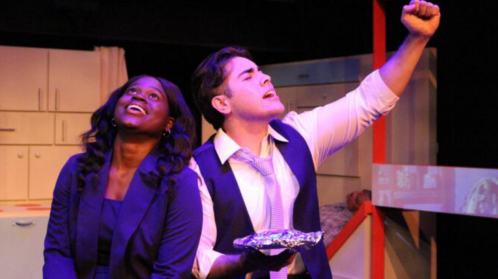
I’ll be honest, when I went in to experience Robbin from the Hood, I was expecting a faithful, modern retelling of Robin Hood. I thought I would find stereotypical references such as capers and forest friends. Instead, I found myself invested in the tale of Robbin, an ambitious, hot-tempered, seventeen year old girl who lives in an inner-city neighborhood. Her hopeless surroundings caused by poverty drives her to look for a way out.The play opens with an elderly man in a wheelchair flipping through newscasts. Sounds of dystopian news reports on the rising poverty rates fill the intimate theater, until the man eventually turns on The Lone Ranger. The relative calm of the scene is quickly interrupted by the boisterous arrival of Robbin (Iesha Daniels). The play only gets more energetic from there, with the first showing of Juan, Robbin’s spirited best friend. His vibrant nature is what kicks this play into high gear, as the two feed on each other’s zeal. It’s pretty clear from the get-go that you’re in for a ride. This liveliness carries through the whole first act. It’s here where we learn that Robbin's math genius and Juan’s artistic giftedness have earned them summer-long internships at Kennedy Global, a multi-billion dollar company. Despite the rather menial work they’ve been assigned, it’s still more stimulating than their academic environment, which was underfunded and overpopulated. They hope to climb the corporate ladder out of poverty and finally be able to take care of their families. This is the act that also introduces two Kennedy Global executives, Kyle and Margaret, whose initial generosity contrasts with their ultimate motives. Despite Kyle’s early misgivings about hiring teens from at-risk neighborhoods, he is reluctantly convinced by an insistent Margaret to let them join the company. Robbin and Juan don’t seem to notice any red flags however, as they quickly settle into their new, high-paying jobs.One thing that really stood out to me was the acting. Robbin’s (Iesha Daniels) confident, sassy attitude is balanced by her moments of vulnerability. The scenes where she worries over her ailing grandfather and financial situation are the ones that best enrich the play. Juan (Enrike Llamas) has complexity as both a funny best friend and a person who’s growing weary of his unpromising surroundings. William L. Warren, who played Grandpa Percy, was convincing in his portrayal of a beloved elderly man facing decline. His shuffling feet, shaky grasp, and weathered voice helped make every moment of his stage time thoroughly believable. There are no stock characters here, every role is complex and well-defined.After a ten minute intermission, I returned to the theater excited for act two. Much to my surprise and delight, I found myself enjoying act two even more than its predecessor. The restless energy of the first act has now subsided. It has been replaced with more reflective moments of emotion that reveal an array of character motivations. I had the opportunity to interview the actors following the show, and as starring actor Iesha Daniels put it, “I think the physical energy of the first half is what drives the emotion in the second half.” This is made clear in the prison scene with Robbin and her incarcerated, yet beloved Uncle Charlie (Joshua R. Lamont). The scene serves as the crucial turning point where Robbin learns deeply disturbing truths about the way Kennedy Global makes their money. The worst part is that these truths harm the ones she loves most. She now faces a conflict of interest between trying to do what’s right, and keeping a job that allows her to financially provide for her family. At only seventeen, our protagonist is forced to ask herself some pretty difficult questions. How far should one go to end cycles of poverty that plague your community? Is it worth the immediate risk, especially when you have been given an opportunity no one else you know has? An answer to these questions seems to appear in the form of an abandoned community project that Robbin hopes to revitalize. Her quest to do so will have the audience completely invested in the many twists and turns she faces along the way. While I was pleasantly surprised by the deviations the play took from the original Robin Hood, similarities between the two are still present upon reflection. Beyond the obvious theme of stealing from the grossly wealthy to empower the impoverished, Robbin from the Hood owes a lot of its impact to the original story. Indeed, there are no Merry Men clad in Lincoln green for this retelling, nor are there any crossbows to be slung. But what the two stories do have in common is the scrappy underdog spirit shared by the two protagonists. Both Robins are temprental, with a tendency to scoff in the face of authority. And yet, both Robins have a caring side to them, a side willing to do anything for the ones they love. Juan serves as a combination of Will Scarlet and Little John, Robin Hood’s two most loyal friends. But perhaps one of the strongest parallels is the fact both Robins pay a price for their biggest act. Robin Hood dies after killing the corrupt Guy of Gisbourne, in an effort to protect his community, and Robbin faces a harsh punishment for doing the same. Their final sacrifice makes them all the more noble.The thing that sets Robbin from the Hood apart from its predecessor is the way it portrays the experiences of talented, impoverished youth. Robbin’s potential is ultimately left untapped and punished, simply because she doesn’t obey the corrupt status quo. Iesha M. Daniels, that actor that plays Robbin herself says, “The ending is a really crucial element to the play because it fully grounds us in reality. This is what happens to girls like Robbin. Black and brown girls who are brilliant, compassionate, and want to change the world and support their communities are crushed and suppressed again and again.” Robbin represents the experience of the disadvantaged, those left behind by a system that seems to work against them. She forces us to question our assumptions about people in at-risk communities. Are they all aimless, or simply given nothing to aim for? And what happens to talented youth when they are left unnurtured? In this way, Robbin exists to remind the audience of an important lesson: not all people get second chances, even when they should. Overall, Robbin from the Hood is definitely a play worth seeing. Its well-crafted plot, strong actor portrayals, and timely message come together to make an engrossing theater experience. Viewers will find themselves shocked at Robbin’s last act of selflessness, which serves as a reminder of how far some will go to level the playing field. This play acts as a sharp rebuke of capitalism and an eye-opening lesson on how corporations take advantage of poor communities. Robbin from the Hood connects with the audience on an emotional level. In the words of William L. Warren, the actor who plays Grandpa Percy, “I think this play is about grief…and especially the love that comes along with it.”